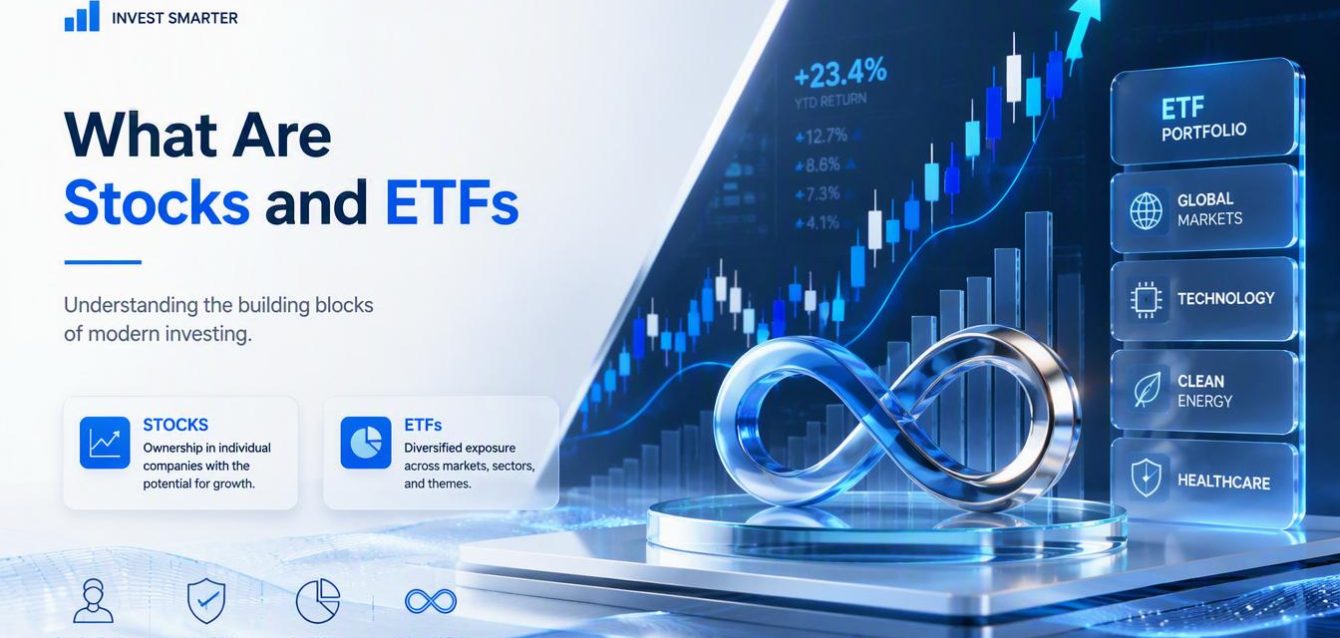
Every investment journey begins with a simple question: where should I put my money? For many people, the first options they encounter are stocks and exchange-traded funds (ETFs). These two investment products have become essential parts of modern investing because they offer different ways to participate in the financial markets while working toward long-term financial goals.
Although they are often mentioned together, stocks and ETFs are not the same. Each offers its own advantages, level of risk, and investment strategy. Understanding how they work can help you choose investments that align with your personal goals, whether you’re looking to grow your savings, generate passive income, or build wealth over time.
“The strongest portfolios aren’t built by guessing tomorrow’s market—they’re built through knowledge, consistency, and patience.” — Infinity Capital Group
Most people begin investing because they want their money to work harder than it would in a traditional savings account. Instead of letting cash sit idle, investing provides the opportunity to participate in the growth of businesses, industries, and global markets.
While investing always involves some level of risk, understanding the fundamentals makes it much easier to make confident financial decisions. Rather than trying to predict every market movement, successful investors usually focus on building a strategy they can maintain for years.
Understanding Stocks
A stock represents ownership in a company. When you purchase shares, you become a shareholder and own a small portion of that business. As the company grows and generates profits, the value of your shares may increase. If the company performs poorly, the value of your investment may also decline.
Public companies issue stocks to raise money for expansion, product development, research, and future growth. Investors provide that capital by purchasing shares, creating a relationship where both the company and its shareholders benefit from long-term success.
Some companies also distribute part of their profits through dividend payments. These dividends provide investors with additional income while they continue holding their shares. Other businesses choose to reinvest their earnings to accelerate future growth instead.
Because stock prices react to company performance, economic conditions, and investor sentiment, they naturally move throughout every trading day. These short-term fluctuations are a normal part of investing and should always be viewed within a broader long-term perspective.
Many experienced investors spend considerable time researching companies before investing. They evaluate financial statements, competitive advantages, management quality, industry trends, and future growth opportunities.
This research helps investors understand not only a company’s current performance but also its long-term potential. While no investment is guaranteed, making informed decisions can improve confidence and reduce unnecessary risk.
What Are ETFs?
While stocks give you ownership in a single company, Exchange-Traded Funds (ETFs) offer a different approach. An ETF is a collection of investments grouped together into one fund. Instead of buying shares in just one business, you can gain exposure to dozens or even hundreds of companies through a single investment.
This built-in diversification is one of the biggest reasons ETFs have become increasingly popular among investors. Rather than depending on the performance of one company, your investment is spread across multiple businesses, helping reduce company-specific risk.
Like stocks, ETFs are traded on major stock exchanges throughout the day. Investors can buy or sell ETF shares during market hours, making them both flexible and accessible for beginners as well as experienced investors.
Whether an ETF tracks a major stock market index, a specific industry, commodities, or bonds, its purpose is to provide broad market exposure while keeping investing simple. Many investors use ETFs as the foundation of their portfolio before adding individual stocks based on their personal investment strategy.
For those who prefer a diversified approach without researching dozens of individual companies, ETFs provide an efficient way to participate in the financial markets.
“Diversification doesn’t eliminate risk, but it can help investors build a stronger and more balanced portfolio over time.” — Infinity Capital Group
Choosing Between Stocks and ETFs
There isn’t a single investment that’s perfect for everyone. The right choice depends on your financial goals, investment experience, and comfort with market risk.
Investors who enjoy researching businesses often choose individual stocks because they have the opportunity to invest directly in companies they believe will grow over time. If those businesses perform well, shareholders may benefit from significant long-term returns.
ETFs, on the other hand, are designed for investors who value diversification and simplicity. Instead of monitoring multiple companies individually, investors gain exposure to an entire group of investments through one fund.
Many experienced investors don’t choose one or the other. Instead, they combine both. An ETF may provide stability and broad market exposure, while carefully selected individual stocks offer opportunities for additional growth.
This balanced approach allows investors to benefit from diversification without giving up the potential rewards of owning high-quality companies directly.
Why Diversification Matters
Every investment carries some level of uncertainty. Markets rise and fall, industries change, and even successful companies can experience challenging periods.
Diversification helps reduce the impact of these uncertainties by spreading investments across multiple assets rather than relying on one company or one sector alone.
Imagine investing your entire portfolio in a single business. If that company experiences unexpected difficulties, your investment could suffer significantly. Now imagine owning shares in hundreds of businesses across different industries. Even if one company struggles, the overall portfolio may remain more stable because other investments continue performing well.
This principle is one of the main reasons financial professionals often recommend diversified portfolios for long-term investors.
Rather than trying to predict which company will become tomorrow’s biggest winner, many successful investors focus on creating a balanced portfolio that can perform steadily under different market conditions.
A diversified strategy doesn’t remove risk entirely, but it can help make investing more consistent and manageable over the long run.
Getting Started with Investing
Starting your investment journey doesn’t require years of experience or a large amount of money. What matters most is having a clear understanding of your financial goals and choosing investments that match your level of risk and long-term objectives.
Before making your first investment, take time to learn how the financial markets operate and how different investment products fit into your overall strategy. Understanding the basics can help you make informed decisions instead of reacting to short-term market movements.
It’s also important to invest consistently rather than trying to predict the perfect time to enter the market. Many successful investors focus on building their portfolios gradually, allowing their investments to grow over time through patience and discipline.
As your knowledge grows, you can continue adjusting your portfolio to reflect your changing financial goals while maintaining a long-term perspective.
“Successful investors focus less on timing the market and more on spending time in the market.”
— Infinity Capital Group
Common Mistakes New Investors Make
Every investor makes mistakes at some point, especially in the beginning. The key is learning from those experiences and avoiding decisions based on emotions rather than facts.
One of the most common mistakes is investing without doing enough research. Buying a stock simply because it’s trending or following investment advice without understanding the company can lead to unnecessary risk.
Another mistake is expecting quick profits. Financial markets naturally experience periods of growth and decline, and successful investing is usually measured over years rather than days or weeks.
Some investors also put all of their money into a single company or sector. While this may offer higher potential returns, it also increases risk if that investment performs poorly. A diversified portfolio can help reduce this risk and create a more balanced investment strategy.
Finally, emotional decision-making often causes investors to buy when prices are high and sell during market declines. Remaining patient and sticking to a long-term investment plan is generally a more effective approach.
Building a Strong Investment Strategy
Every investor has different financial goals, which means there is no one-size-fits-all investment strategy. Some people prioritize long-term growth, while others focus on generating regular income or preserving capital.
A balanced portfolio often includes a combination of different asset types. Individual stocks can provide opportunities for higher growth, while ETFs can offer broader market exposure and diversification. Together, they can complement each other and help create a portfolio that’s better prepared for changing market conditions.
Reviewing your investments periodically is also important. As markets change and your financial goals evolve, making thoughtful adjustments can help keep your portfolio aligned with your long-term objectives without reacting to every short-term market movement.
Investing should always be viewed as an ongoing journey rather than a one-time decision. Continuing to learn, staying informed, and maintaining realistic expectations can make a meaningful difference over time.
Final Thoughts
Stocks and ETFs are both valuable investment tools, and understanding the difference between them is an important step toward becoming a more confident investor. While stocks provide direct ownership in individual companies, ETFs offer instant diversification by combining multiple investments into a single fund.
Neither option is inherently better than the other. The right choice depends on your financial goals, investment experience, and personal approach to risk. Many investors choose to combine both, creating a diversified portfolio that balances growth opportunities with long-term stability.
Regardless of where you are in your investment journey, education remains one of your most valuable assets. Taking the time to understand how financial markets work, investing with a long-term mindset, and making informed decisions can help you build a stronger financial future.
At Infinity Capital Group, we’re committed to helping investors navigate the financial markets with confidence by providing educational resources and market insights that support informed decision-making. Whether you’re investing for the first time or expanding an existing portfolio, building knowledge today can help create better opportunities tomorrow.